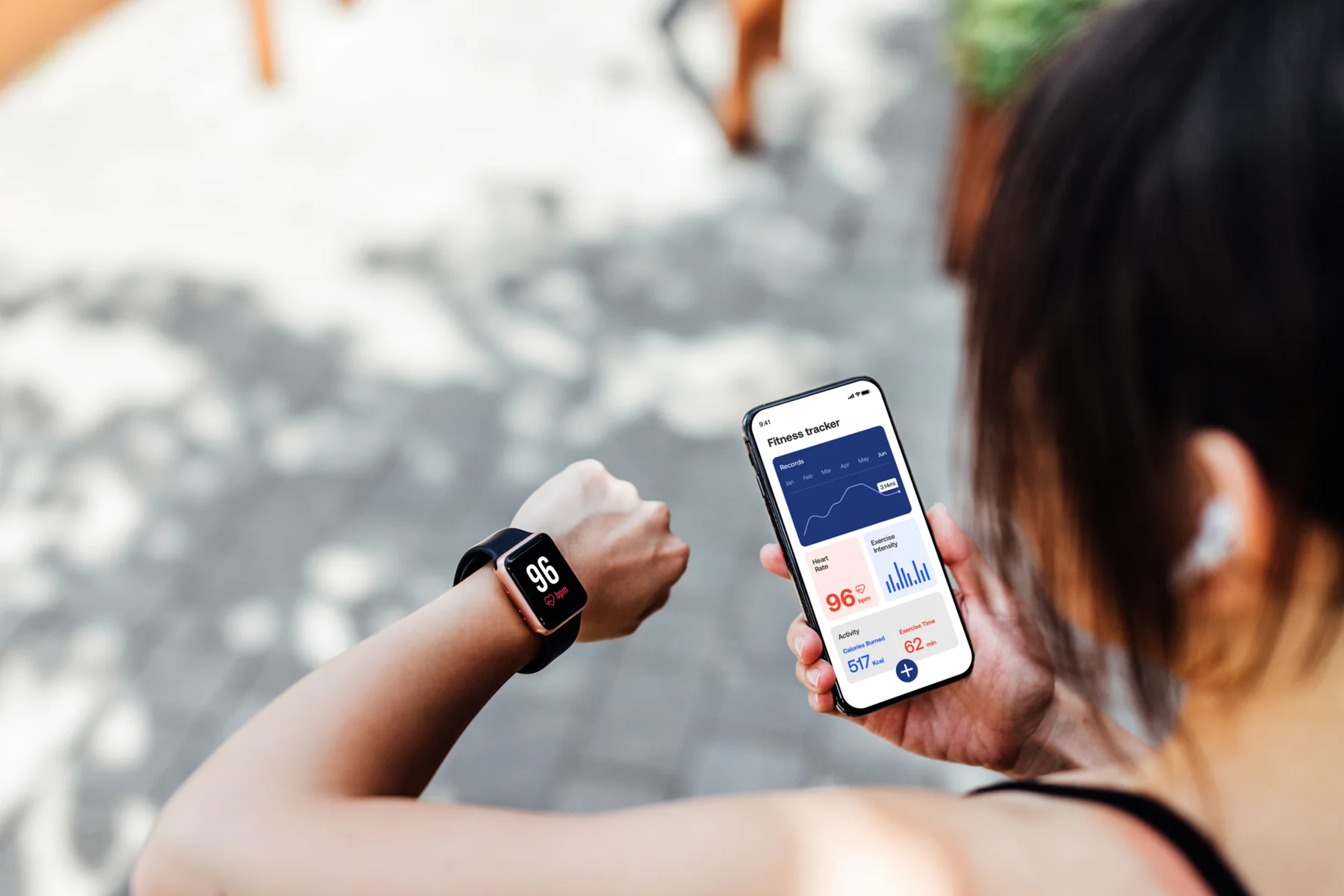
A lot of people now start the day by checking in with a device before they check in with themselves.
They wake up, grab their phone, open an app, and find out how they supposedly slept.
Then they look at recovery, readiness, strain, steps, heart rate, HRV, calories, and whatever else the tiny health accountant on their wrist decided to track overnight.
This is not some niche fitness nerd behavior anymore. Wearable technology was ranked the number-one fitness trend for 2026 by the American College of Sports Medicine, based on its annual survey of more than 2,000 clinicians, researchers, and exercise professionals.
So the question is not whether people are going to use this stuff.
They already are.
The better question is whether they know what to do with the information.
Sometimes the data is helpful.
It can confirm what you already felt. You slept terribly, your resting heart rate is elevated, and your body feels like a wet paper bag. Good to know. Maybe today is not the day to force a personal record.
Other times, the data adds noise.
You wake up feeling decent, see a low sleep score, and start second-guessing yourself.
Or you feel run down, but the app says your recovery is great, so you wonder if you’re just being soft. Or you see a calorie number after a workout and treat it as more precise than it really is.
That’s where wearables get interesting.
Not because they’re bad. They’re not. I like data. I like feedback. I like tools that help people notice patterns in their lives.
But data still needs common sense.
And that’s where a lot of people get stuck.
The Data Is Useful. It’s Also Incomplete.
Your watch can measure signals.
It can estimate sleep. It can track heart rate. It can count steps. It can show trends. It can give you information you might not have noticed otherwise.
That’s valuable.
Research supports this middle ground. A 2024 umbrella review of systematic reviews found that consumer wearables can be useful for measuring some health variables, especially things like heart rate and step counts, but accuracy varies depending on the device, the metric being measured, and the situation. Measures like energy expenditure are generally less reliable, which is worth remembering before treating “calories burned” like sacred math.
Sleep tracking has similar limitations. The American Academy of Sleep Medicine has noted that consumer sleep technology is becoming more common and potentially useful, but these tools still need careful interpretation and should not be treated as a replacement for clinical sleep evaluation when real sleep problems are present.
That is the point.
The data is useful.
It is also incomplete.
Your device does not know the whole story.
It doesn’t know your dog woke you up three times. It doesn’t know your kid was sick. It doesn’t know you had a stressful conversation yesterday, ate later than usual, drank more than normal, traveled, trained hard, or spent the evening doom-scrolling like a raccoon with Wi-Fi.
It also doesn’t know exactly how much capacity you have today.
That still requires you to pay attention.
The “facts over feelings” crowd can sound very reasonable in fitness. On the surface, it feels mature. Objective. Disciplined. No excuses. Just numbers, targets, data, outcomes.
But you are not a collection of numbers.
You are a human being.
And anything that teaches people to ignore how they feel eventually becomes dehumanizing. Feelings are not always accurate, but they are always informative. Fatigue, hunger, soreness, stress, dread, energy, mood, and motivation all tell us something about the body and the life that body is living inside.
At the same time, leaning too far the other direction has its own problems.
“Just listen to your body” sounds nice until you remember what modern life does to the body.
Most adults are not accidentally moving enough, sleeping enough, and eating enough nutrient-dense food just by intuition. In 2024, only 47.2% of U.S. adults met federal aerobic physical activity guidelines during leisure time. Healthy People 2030 data also shows that meeting both aerobic and muscle-strengthening guidelines is much less common, with the highest age-group rate only reaching 32.1% among adults ages 18–44 in 2024.
Sleep tells a similar story. CDC/NCHS data reports that 69.5% of U.S. adults got sufficient sleep in 2024, meaning roughly 3 in 10 adults did not. Nutrition is not exactly crushing it either. CDC data from 2019 found that only 12.3% of U.S. adults met fruit intake recommendations and only 10.0% met vegetable intake recommendations.
So no, the answer is not feelings only.
And it is not facts only.
The best work happens in the overlap.
You need subjective experience and objective data. You need what you feel and what you can measure. You need the story and the numbers.
Early in my career, I borrowed a practice from nurses I worked with: SOAP notes.
Subjective. Objective. Assess. Plan.
What does the person report?
What can we measure or observe?
What does it likely mean?
What are we going to do next?
That framework still holds up.
Your wearable gives you some objective data. Your body gives you subjective feedback.
Common sense helps you assess both and make a plan.
The number starts the conversation.
It should not end it.
The Skill Is Knowing What the Data Should Change
The most useful question is not, “What score did I get?”
It’s, “What should this information change?”
Sometimes the answer is nothing.
A low sleep score after one rough night might not need a full lifestyle audit. You may just need to go to bed earlier tonight and move on with your life.
A lower step count might tell you your day had less movement than usual. That doesn’t mean you failed. It may mean your environment did not create many chances to move.
So maybe you build in a short walk tomorrow.
A lower recovery score after a hard training week might be a useful nudge. Maybe you reduce intensity. Maybe you keep the workout but stop one or two sets earlier. Maybe you warm up and see how you feel. Maybe you take the rest day.
There is a range of reasonable responses.
That’s the point.
The wearable gives you information. You still have to interpret it inside the reality of your life.
One data point rarely deserves a dramatic reaction.
Patterns matter more.
If your sleep has been poor for three weeks, that matters.
If your resting heart rate is trending up while your energy is trending down, that matters.
If your step count quietly dropped when work got stressful, that matters.
The device can help you notice those patterns.
But noticing is only the first step.
You still have to decide what a sane response looks like.
Health Can’t Be Reduced to a Daily Grade
I learned this one the hard way.
Years ago, I used to grade people’s sleep, workouts, and nutrition on a monthly basis using the same standardized grading scale we all knew from school.
A’s, B’s, C’s. The whole thing.
On paper, it made sense. Simple feedback. Clear standards. Easy to understand.
In practice, it had a pretty low success rate.
The people who thrived with it were usually the same people who thrived in school. They liked the structure. They liked the grade. They liked seeing where they stood.
Everyone else reacted about how you would expect.
The dropouts did what dropouts do when grades came up.
They disappeared.
Not because they were lazy. Not because they didn’t care. But because turning health into another report card often recreates the same shame, pressure, and avoidance people already carry from other parts of life.
Wearables can create a similar dynamic.
Sleep gets scored.
Movement gets scored.
Workouts get scored.
Recovery gets scored.
Food gets logged.
Calories get estimated.
Pretty soon, a person is not just living a life. They’re managing a dashboard.
That dashboard is more visible and accessible than at any point in history. More people than ever can see their steps, sleep trends, heart rate, recovery, calories, and training load.
That does not mean we all know how to read it.
For some people, the dashboard helps. It gives structure. It makes patterns visible. It encourages a little more movement or a better bedtime.
For others, it becomes one more place to feel behind.
Most people are somewhere in the middle.
They like the feedback, but they also feel the pressure. They want the information, but they don’t always know what to do with it. They enjoy closing the rings until the rings start feeling like tiny digital landlords collecting rent.
This is especially common with people who already lean toward perfectionism.
They don’t just use the data as feedback.
They use it as evidence.
Evidence that they’re failing.
Evidence that they’re not disciplined enough.
Evidence that they should be doing more.
That is a rough way to live.
And it usually does not lead to better health. It leads to more tension around health.
A Better Way to Use the Data
Use your wearable to study your life, not judge it.
Look for patterns.
Do you sleep worse after alcohol?
Do late meals affect your rest?
Does your energy improve when you walk more?
Does your training suffer when work stress is high?
Do your best weeks have anything in common?
That’s useful information.
But don’t hand your common sense over to the device.
If your watch says you recovered well but you feel awful, that is useful information too.
If your watch says your sleep was poor but you feel fine, that is also worth noticing.
If your calorie burn seems suspiciously precise, be suspicious. Calorie estimates from wearables can be helpful for broad trends, but they are not precise enough to micromanage your food around them.
The best use of wearable data is not obedience.
It is better self-awareness.
The goal is not to obey the number.
The goal is to understand yourself better.
That is less flashy than a readiness score, but much more useful.
The Human Part Still Matters
Wearables are going to keep improving.
AI coaching based on individual biometrics is already on the market. It is more specific, more complex, and more personalized than anything a coach or healthcare professional could have offered for most of human history.
That trend is going to continue.
The data will get better. The apps will get smarter. The recommendations will become more individualized. Some of that will help.
But no matter how good the technology gets, none of it can move your legs for you.
It cannot close your eyes on time for bed.
It cannot eat your food.
It cannot decide what kind of person you want to become.
It cannot fully understand your values, your season of life, your responsibilities, your relationships, or your capacity on a hard week.
It can only tell part of the story.
The other part is written by what you do with the information.
And that is where common sense still matters.
Your watch can give you data.
Your body can give you feedback.
Your job is to bring both into the same room and make a reasonable decision.
That skill is not as shiny as a new device.
But it is where health actually happens.
Sources
American College of Sports Medicine. “The Future of Fitness: ACSM Announces Top Trends for 2026.” ACSM ranked wearable technology as the number-one fitness trend for 2026, based on its annual survey of more than 2,000 clinicians, researchers, and exercise professionals.https://www.acsm.org/top-fitness-trends-2026/
Fuller, D., et al. “Keeping Pace with Wearables: A Living Umbrella Review of Systematic Reviews Evaluating the Accuracy of Consumer Wearable Technologies in Measuring Various Physiological Outcomes.” Sports Medicine, 2024. This review summarizes evidence on the accuracy of consumer wearables for outcomes such as heart rate, sleep, physical activity, and energy
expenditure.https://link.springer.com/article/10.1007/s40279-024-02077-2
Khosla, S., et al. “Consumer Sleep Technology: An American Academy of Sleep Medicine Position Statement.” Journal of Clinical Sleep Medicine, 2018. This position statement discusses the potential benefits and limitations of consumer sleep technology and notes that these tools should not be used to diagnose or treat sleep disorders.https://www.ncbi.nlm.nih.gov/pmc/articles/PMC5940440/
Centers for Disease Control and Prevention / National Center for Health Statistics. “Aerobic Physical Activity Among Adults Age 18 and Older: United States, 2024.” This report found that 47.2% of U.S. adults met federal aerobic physical activity guidelines in 2024.https://www.cdc.gov/nchs/products/databriefs/db555.htm
Office of Disease Prevention and Health Promotion. “Increase the proportion of adults who do enough aerobic and muscle-strengthening activity — PA-05.” Healthy People 2030 reports that adults ages 18–44 had the highest 2024 rate of meeting both aerobic and muscle-strengthening guidelines, at 32.1%.https://odphp.health.gov/healthypeople/objectives-and-data/browse-objectives/physical-activity/increase-proportion-adults-who-do-enough-aerobic-and-muscle-strengthening-activity-pa-05/infographic
Centers for Disease Control and Prevention / National Center for Health Statistics. “FastStats: Sleep Health.” CDC/NCHS reports that 69.5% of U.S. adults got sufficient sleep in 2024.https://www.cdc.gov/nchs/fastats/sleep-health.htm
Lee, S. H., Moore, L. V., Park, S., Harris, D. M., & Blanck, H. M. “Adults Meeting Fruit and Vegetable Intake Recommendations — United States, 2019.” Morbidity and Mortality Weekly Report, 2022. This CDC report found that 12.3% of U.S. adults met fruit intake recommendations and 10.0% met vegetable intake recommendations in 2019.https://www.cdc.gov/mmwr/volumes/71/wr/mm7101a1.htm