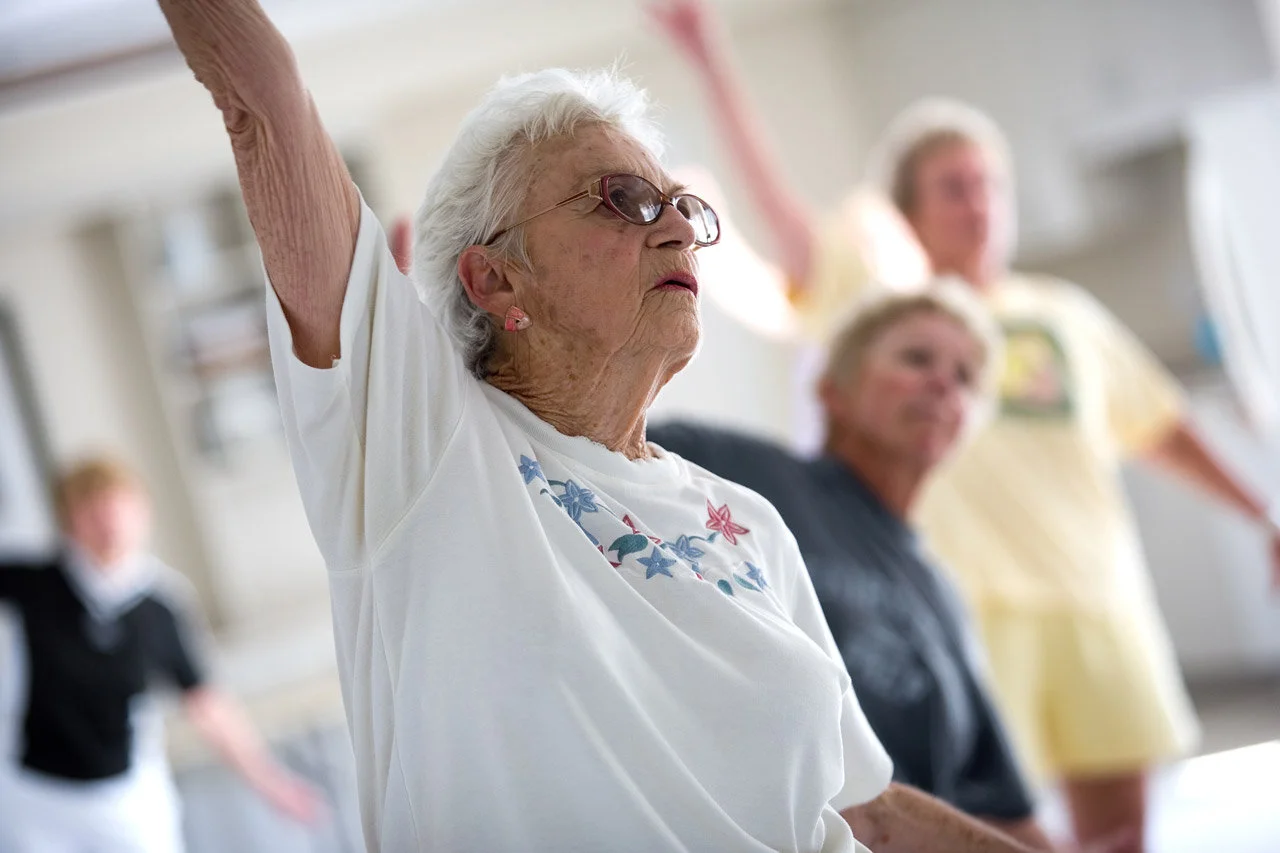
At some point, most people feel it.
Maybe it shows up when a workout you used to breeze through now leaves you sore for two days. Maybe it happens when your knees start talking during stairs. Maybe it’s the first time your child, younger coworker, or some annoyingly springy twenty-something beats you at something physical.
There’s a quiet moment when many people realize: My body is changing.
That can feel unsettling. But it can also be useful.
Because the real question is not, “Can I avoid aging?”
You can’t.
The better question is: How much influence do I have over how I age?
A long-term Swedish study followed the same group of people from age 16 to 63, measuring aerobic fitness, muscular endurance, muscular power, and physical activity across 47 years. The findings were sobering, but also deeply encouraging: fitness does decline with age, but the rate and severity of that decline are strongly shaped by what people do across their lives.
In other words, aging is real.
But decline is not a fixed sentence.
What the Study Found
Researchers began tracking 427 Swedish teenagers in 1974 when they were 16 years old. Over the next 47 years, that same group was tested at nine different points, all the way up to age 63. They measured three major areas of physical fitness:
Aerobic capacity, which reflects how well the heart, lungs, and muscles use oxygen.
Muscular endurance, measured through a bench press repetition test.
Muscular power, measured through a vertical jump test.
By age 63, participants had lost between 30 and 48 percent of their peak physical capacity, depending on the measure.
That may sound grim at first, but the details matter.
Aerobic capacity peaked around age 26 for men and age 31 for women. By age 63, both men and women had declined to roughly 25 mL/kg/min, which represented about a 37–40 percent drop from peak levels.
Muscular endurance peaked in the mid-30s. By age 63, men had lost about 35 percent and women about 32 percent of their peak bench press endurance.
Muscular power showed the steepest decline. Women peaked earliest, around age 19, while men peaked around age 27. By age 63, men had lost about 41 percent of their peak jumping power, and women had lost about 48 percent.
That’s the hard truth: physical capacity does not stay at its peak forever.
But here’s the hopeful part.
The differences between people became much larger with age. At 16, participants were relatively close together in fitness. By 63, the gap between the more fit and less fit participants had widened dramatically.
That matters because it tells us something important: lifestyle compounds.
Two people can start from a similar place in youth and end up in very different places by older age depending on their habits, activity levels, training history, injuries, nutrition, sleep, and willingness to keep moving.
Genetics mattered, of course. The researchers estimated that stable individual traits accounted for about 30–50 percent of performance differences over the study period.
But that leaves a lot of room for choices.
Not perfect choices.
Not obsessive choices.
Just repeated choices.
Starting Later Still Works
One of the most important findings from this study is that becoming active later in life still helped.
People who were active at age 16 tended to maintain better fitness over time. That part is not surprising.
But people who switched from inactive to active at any point during the study also improved. Even those who became active in their 40s, 50s, or early 60s saw measurable gains.
On average, becoming active was associated with improvements of about 6–7 percent in aerobic capacity, 11 percent in bench press performance, and 4 percent in vertical jump.
Now, depending on your personality, you might read that and think, “Only that much?”
But remember: the study grouped people together broadly. Some may have only recently become active. Some may have been inconsistent. Some may have started, stopped, restarted, and drifted.
The practical takeaway is not that later-life exercise produces magical overnight transformation.
The takeaway is better than that:
Your body still responds.
Even later in life.
Even if you’ve been inactive.
Even if you’re not starting from where you wish you were.
The human body is not a machine that simply breaks down. It is an adaptive organism. Give it a reason to improve, and it usually gives something back.
The Trap: Feeling Weaker, Then Doing Less
One of the quietest dangers of aging is not aging itself.
It’s the slow negotiation with limitation.
You get winded on stairs, so you start taking the elevator.
Your knees ache on longer walks, so you stop walking as far.
Groceries feel heavier, so you carry less.
Getting up from the floor feels awkward, so you stop getting down there.
None of these choices are irrational. In the moment, they make sense. They are reasonable accommodations.
But over months and years, the body listens.
The less often you ask your body to climb, carry, bend, push, pull, balance, squat, or breathe hard, the less capable it becomes.
That is the spiral: feeling weaker leads to doing less, and doing less leads to feeling weaker.
This is where compassion matters.
There is no shame in needing to adjust. Pain, injury, illness, life stress, and age all change what your body can tolerate. Some accommodations are wise and necessary.
But we want to be careful not to confuse temporary adjustment with permanent surrender.
The goal is not to chase your 25-year-old body.
The goal is to preserve function, confidence, and independence for as long as possible.
Can you still get up from a chair without using your hands?
Can you carry your groceries?
Can you walk comfortably?
Can you climb stairs when needed?
Can you get on and off the floor?
Can you travel, play with your kids or grandkids, work in the yard, lift your suitcase, or enjoy your hobbies without feeling trapped by your body?
That is what fitness is really about as we age.
Not punishment.
Not vanity.
Freedom.
Power Declines Fast, So Train It Carefully
One of the most striking findings from this study was the decline in muscular power.
Power is your ability to produce force quickly. It’s not just how strong you are. It’s how quickly you can use that strength.
Power helps you catch yourself if you trip. It helps you climb stairs, stand up quickly, change direction, and move with confidence.
And according to this research, power may decline earlier and more sharply than other fitness qualities.
That does not mean everyone needs to start doing box jumps or explosive Olympic lifts. For many people, that would be unnecessary or even inappropriate.
But it does mean we should not ignore the quality of moving with intent.
For some people, that might mean sit-to-stands done with a little more speed.
For others, it might mean step-ups, carries, light medicine ball throws, controlled jumping, hill walking, or strength training with a focus on crisp movement.
The method depends on the person.
The principle stays the same:
As we age, we need to train not only strength, but the ability to use strength well.
You Can’t Control the Curve, But You Can Shape It
This study reinforces something both humbling and empowering.
The general pattern of physical performance is biological. Most people peak somewhere between their late teens and mid-30s depending on the quality being measured.
That part is not really up for negotiation.
But three things are still highly influenceable.
You can influence how high your peak gets by training, eating well, sleeping enough, and building a body that is capable before decline begins.
You can influence how slowly you decline by staying active, lifting weights, maintaining cardiovascular fitness, managing body weight, and continuing to challenge your body.
You can influence where you land later in life by refusing to let inactivity quietly take over.
Aging lowers the ceiling over time.
But your habits determine how much room you still have beneath it.
That is the useful distinction: some decline is inevitable, but the severity of decline is not entirely predetermined.
What This Means for You
If you are young, build now.
Do not assume your body will always be forgiving. Train strength. Build cardiovascular fitness. Learn how to move well. Develop the habits before you urgently need them.
If you are in midlife, do not panic.
This is not the beginning of the end. It is the beginning of needing to train with more intention. You may not recover like you did at 22, but you can still build muscle, improve endurance, gain strength, and feel dramatically better.
If you are older, do not write yourself off.
Starting now still matters. Walking matters. Strength training matters. Balance work matters. Mobility matters. Consistency matters.
The body may not respond as quickly as it once did, but it still responds.
And if you have been inactive, start smaller than your ego wants.
That might mean a ten-minute walk.
One set of sit-to-stands.
A few light strength exercises twice per week.
A short walk after meals.
A beginner resistance training plan.
The best program is not the one that impresses people.
The best program is the one you can repeat.
Actionable Steps
Start with the basics: walk regularly, lift weights two to four times per week, and include some form of cardiovascular training that raises your breathing.
Train your legs, hips, back, chest, shoulders, and core. You do not need a complicated program, but you do need repeated exposure to effort.
Pay attention to what you have quietly stopped doing. Stairs, walks, carrying things, getting on the floor, yard work, recreational activities—these are clues. They show you where capacity may be slipping.
Then rebuild from the smallest possible version.
If long walks bother your knees, start with short walks.
If stairs leave you winded, practice a few flights at a manageable pace.
If weights intimidate you, start with machines, bands, or bodyweight exercises.
The goal is not to prove anything.
The goal is to keep your body in the conversation.
Closing Thoughts
After 15 years of coaching, I’ve watched this play out in real people, not just in research charts.
The people who age well are not always the ones who trained the hardest when they were young. They are usually the ones who keep finding a way to stay in the game.
They adapt.
They scale things down when needed, but they do not disappear from their own health.
I’ve worked with people who thought they were too old, too weak, too busy, too injured, or too far gone to make meaningful progress. And time after time, the turning point was not dramatic. It was usually simple: walking again, lifting consistently, practicing balance, eating enough protein, sleeping better, or rebuilding confidence one small win at a time.
Fitness is not about clinging to your peak forever. That peak passes for everyone.
The deeper goal is to build enough strength, endurance, and resilience that you can keep living your life with freedom.
You may not control the fact that time moves forward.
But you do have a say in how you meet it.
Your health is your wealth - Michael Beiter
Personal Trainer
Nutrition, Sleep, Stress management, and Recovery coach
References
Westerståhl M, Jörnåker G, Jansson E, Aasa U, Ingre M, Pourhamidi K, Ulfhake B, Gustafsson T. Rise and Fall of Physical Capacity in a General Population: A 47-Year Longitudinal Study. Journal of Cachexia, Sarcopenia and Muscle. 2025;16.
Lazarus NR, Harridge SDR. Declining Performance of Master Athletes: Silhouettes of the Trajectory of Healthy Human Ageing? Journal of Physiology. 2017;595(9):2941–2948.
Rogers MA, Hagberg JM, Martin WH, Ehsani AA, Holloszy JO. Decline in VO2max With Aging in Master Athletes and Sedentary Men. Journal of Applied Physiology. 1990;68(5):2195–2199.
Trappe S, Hayes E, Galpin A, Kaminsky L, Jemiolo B, Fink W, Trappe T, Jansson A, Gustafsson T, Tesch P. New Records in Aerobic Power Among Octogenarian Lifelong Endurance Athletes. Journal of Applied Physiology. 2013;114(1):3–10.
Westerståhl M, Barnekow-Bergkvist M, Hedberg G, Jansson E. Secular Trends in Body Dimensions and Physical Fitness Among Adolescents in Sweden From 1974 to 1995. Scandinavian Journal of Medicine & Science in Sports. 2003;13(2):128–137.