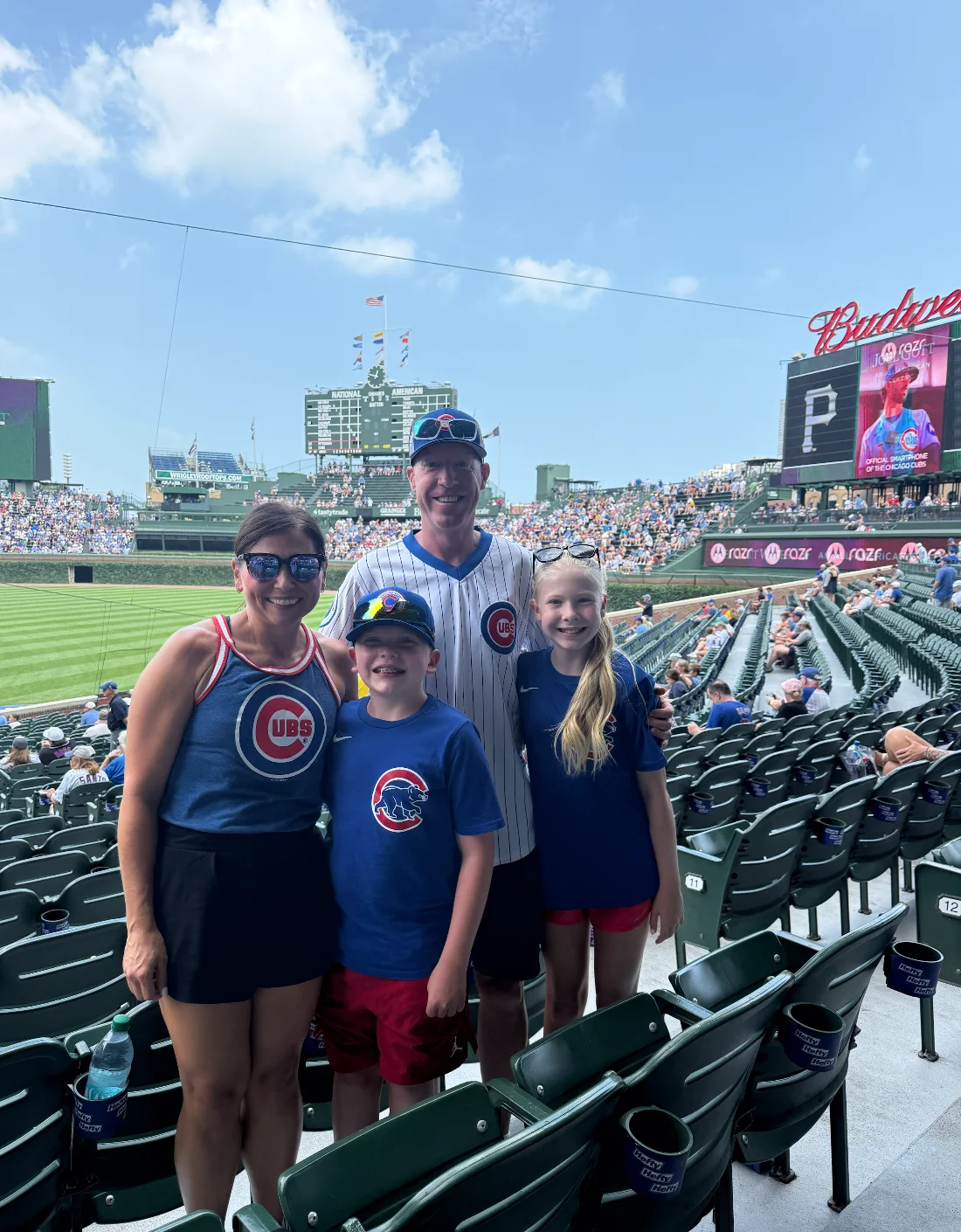
Ten years ago, Carmen and I met in the Merle Hay Mall food court.
Which is funny, because if you were writing the movie version of a decade-long health transformation, you probably wouldn’t start it under mall lighting, next to a Maid Rite, in a food court.
But that's how Carmen and I began, and it speaks to the unremarkable interactions that lead to real change.
Not with a dramatic before-and-after moment. Not with someone declaring, “This is it,” while staring nobly into the middle distance. Not with a perfect plan, a new supplement stack, or a sudden personality transplant.
Usually, it starts with a conversation.
A person sits down and says, in one way or another, “I think I need help doing this differently.”
That was Carmen.
We met at the mall first. Then at our friend Megan’s as a group with her coworker Kelly. Then in my office at 22nd Street Barbell.
Then across years of check-ins, spreadsheets, apps, course corrections, life changes, holidays, parenting seasons, travel, frustration, honesty, wins, setbacks, and all the very unglamorous middle parts that make health actually happen.
Recently, Carmen went back to the top of her spreadsheet and realized we had been working together for ten years.
Ten years.
When I asked her if there was anyone else in her life she had worked with that long, she paused and said:
“Just you and my hair stylist.”
Which, honestly, feels like the correct inner circle.
There are not many people we keep letting near our real lives for a decade. Especially not the parts involving aging, body image, stress, alcohol, perfectionism, family, hormones, strength training, food tracking, and the ongoing question of how to take better care of ourselves without becoming insufferable.
That kind of relationship does not happen because someone found the perfect macro calculator.
It happens because there is trust.
And then that trust gets tested by actual life.
We built it, tested it, and it's still standing.
In the Beginning, It Was About Now
When Carmen first started, she was not thinking much about Carmen at 45, 60, 70, or 80.
Most people aren’t.
It's not a character flaw. That is being human.
When you are busy raising kids, working, managing a household, dealing with stress, and trying to feel decent in your clothes, “future me” can feel like a theoretical person. A nice idea. Someone you vaguely hope is doing well, somewhere down the road.
Early on, her focus was more immediate.
Weight. Tightness. Cardio. Food. The scale. The feeling of, “Am I over?”
She wanted control. The usual mix of urgency and frustration that brings a lot of people into coaching.
And to be clear, those things matter. I’m not going to pretend people come to coaching because they woke up one morning deeply moved by the long-term preservation of muscle.
A lot of people come in because something feels off now.
But one of the biggest changes I have seen in Carmen over the last ten years is that her frame has widened.
She is no longer only thinking about how she looks next month.
She is thinking about what kind of woman she is going to be in her 70s, 80s, and 90s.
She values independence. Energy. Strength. Confidence. Quality of life. What her kids are learning from the way she talks about food, exercise, body image, and effort.
Those are no small shifts, that is identity-level change.
At some point, Carmen stopped chasing a look and started building a life. The looks took care of themselves.
From Cardio Queen to Someone Who Lifts
Before we worked together, Carmen was what a lot of women from her generation were taught to become: a cardio queen.
Do more. Sweat more. Burn more. Earn your food. Chase the feeling that you had done enough.
Strength training was not the foundation. It was the accessory, if it happened at all.
That has changed.
Carmen now has ten years of strength training behind her. Ten years of learning that muscle is not just about aesthetics. It is about aging better. It is about capability. It is about confidence. It is about being harder to break, physically and psychologically.
And maybe most importantly, strength training is now her preference.
That's such a big win.
There is a big difference between forcing yourself to do something because you were told it is good for you and becoming the kind of person who genuinely seeks it out because they feel it.
Carmen has done thousands of workouts over the last decade.
3,432 to be exact.
That number deserves a second.
Because 3,432 workouts is not “trying to be active.”
That is not a phase.
That is not motivation.
That is identity.
That is someone who trains.
Through travel. Through kids’ schedules. Through imperfect sleep. Through stress. Through holidays. Through low-energy days. Through all the weeks where life did not politely clear the calendar and say, “Please, Carmen, prioritize your wellness journey.”
She showed up anyway.
Not always perfectly. Not always intensely. Not always with some beast-mode nonsense playing in the background.
But consistently enough that it became who she is.
That is the part people miss about long-term change. Everyone is busy yapping about making it a lifestyle, meanwhile, we've been doing it for years.
It does not always look dramatic while it is happening. It looks like another workout.
Another ordinary check-in. Another adjustment. Another day of not making things worse.
Then a decade stacks up, and like Carmen, you realize you are the outlier.
The Real Skill: Flexibility
One of Carmen’s defining traits now is that she does not really start over anymore.
She flexes.
That might not sound exciting, but in coaching, it is one of the highest-level skills there is.
Most people live in extremes.
They are either on the plan or off the plan. Tracking or not tracking. Exercising hard or doing nothing. Eating perfectly or saying, “Well, I already blew it.”
We treat health like a light switch, then act surprised when we keep ending up in the dark.
Carmen has learned to live in the dimmer switch.
That is where actual consistency lives.
Twenty out of thirty days can be a success.
Loose tracking can be better than no tracking.
A shortened workout can beat a skipped workout.
Weekly tracking might be better than monthly tracking in one season, while monthly tracking might be enough in another.
A few days of scale avoidance does not need to become three weeks of pretending the scale has joined witness protection.
This is spectrum thinking.
And it is one of the major reasons Carmen has lasted.
She still has perfectionistic tendencies. She would tell you that. I would tell you that. The spreadsheet would probably tell you that if spreadsheets were less emotionally detached.
But she is light years ahead of where she was.
She has learned to bend without breaking.
Her superpower is not perfection.
It is flexibility. Thinking on a continuum.
She rarely needs a dramatic reset, few do.
She learned to turn up and turn down, not on and off.
She Has Become Someone Who Tells Herself the Truth
One of the things I respect most about Carmen is that she has become more honest with herself.
Consistently.
She can admit when monthly tracking has gotten too loose.
She can recognize when she is “kicking the can.”
She can call out her own scale avoidance instead of dressing it up as something more noble.
She can say, “I’m not weighing because I don’t think I’ll like the number.”
That level of honesty is rare.
Most people rationalize. They tell themselves the story that feels better in the moment.
They avoid the data, avoid the discomfort, avoid the obvious, and then wonder why things feel confusing.
Carmen has learned to look more directly.
Again, not always immediately. She is still human. Humans are very talented at negotiating with reality, especially when reality involves a scale, a spreadsheet, or the aftermath of a weekend.
But she comes back faster now.
And when she comes back, she usually knows what is happening.
That is the difference between someone who is still searching and someone who has built self-awareness.
She has the habits.
She understands the thinking behind them.
That matters because behavior change is not just about what you do. It is about learning to recognize the thoughts, emotions, and patterns that pull you away from what you said you wanted.
Carmen can see those patterns now.
That does not make them disappear.
But it gives her leverage.
Data Used to Be a Threat. Now It Is Information.
Carmen’s relationship with data has matured.
The scale used to have more power. Tracking could feel like judgment. Numbers could become emotional evidence instead of useful information.
I see it all the time.
A lot of people say they want accountability until accountability hands them a number they do not like.
But over time, Carmen has learned to interpret data instead of only reacting to it.
That does not mean she loves every weigh-in. It does not mean she never avoids it. It does not mean she has become some serene, spreadsheet-loving monk who gently smiles at fluctuations.
No one likes that person.
It means she understands the role of data better.
The number is not a verdict.
It is feedback.
Tracking is not a moral audit.
It is a tool for navigation.
A monthly check-in is not proof that you failed.
It is a chance to adjust before a small drift becomes a bigger one.
This is where Carmen has grown tremendously. She has learned that the problem is usually not lack of knowledge anymore. She knows what works.
Tracking works.
Structure helps.
Accountability helps.
Strength training matters.
Sleep matters.
Alcohol has a cost.
Flexibility works better when it lives inside structure, not when it slowly becomes avoidance wearing Vuori pants.
At this point, there is no great mystery.
The work now is largely continuity.
It is about closing the gap between what she knows and what she does.
Alcohol Changed Because the Math Changed
One of the biggest shifts Carmen named was alcohol.
Ten years ago, alcohol had a much bigger place in her life.
Now, it has a much smaller one.
Not because she became dramatic about it. Not because she needed to turn it into an identity performance. Not because someone scared her straight with a podcast and a ring light.
The math changed.
The pros used to feel worth the cons.
Then they didn’t.
Carmen remembers sitting in my office at 22nd Street Barbell, drawing a T-chart on my whiteboard. Benefits on one side. Costs on the other.
Very sophisticated technology.
A marker. A whiteboard. The ancient coaching art of making the obvious harder to ignore.
But it helped.
Because sometimes people do not need more information. They need to see their own ambivalence laid out in front of them.
Alcohol can be like that.
There are benefits. There are reasons people drink. Social ease. Ritual. Transition. Fun. Numbing. Reward. A way to end the day or blur the edges of stress.
But there are costs too.
Sleep. Recovery. Mood. Appetite. Training quality. Energy. Patience. The next morning.
The subtle feeling that you are borrowing from tomorrow to pay for tonight.
For Carmen, over time, the costs became harder to justify.
That is a grown-up kind of change.
Not forced. Not preachy. Not all-or-nothing.
Just honest.
“The pros don’t outweigh the cons like they used to.”
That sentence is worth more than most health advice.
Because it shows ownership.
It shows that Carmen is not making decisions from rules anymore. She is making them from self-respect and lived experience.
Pause to pat us both on the back.
Minimum Effective Dose Was Not Settling. It Was Strategy.
One of the ideas that has served Carmen well over the years is minimum effective dose.
This can sound underwhelming if you are used to fitness culture screaming at you.
Minimum effective dose does not sell as well as “destroy yourself for 75 days and emerge as a shinier, more dehydrated version of your true self.”
But it works.
Especially for real adults with real lives.
Minimum effective dose asks a better question:
What is the smallest amount of structure, effort, and consistency that keeps you moving in the right direction?
Not the most you can tolerate.
Not the harshest plan you can survive.
Not the version of health that requires every other part of your life to politely shrink.
The smallest effective dose.
For Carmen, that has meant learning when to push and when to adjust. When to tighten tracking and when to zoom out. When to train hard and when to flex. When to use structure as support instead of punishment.
This is not laziness.
This is maturity.
A decade of coaching teaches you that sustainability is not built by constantly asking, “How hard can I go?”
It is built by asking, “What can I keep doing?”
Carmen has learned that.
She has learned that consistency is not the absence of life interference. It is the ability to adapt without abandoning the thing completely.
That is partly why she is still here ten years later.
She Built an Ecosystem, Not Just a Plan
One of the clearest signs that Carmen has changed is that her systems now reflect her actual personality.
She did not just follow a generic plan forever.
We built an ecosystem.
Spreadsheets.
Notes.
Calendar methods.
Apple Watch metrics.
Heart rate variability.
Quotes at 10 a.m.
A family quote wall.
Check-ins.
Adjustments.
Visuals.
Tools.
Reminders.
This was all structure that makes sense to her.
This matters because many people fail not because they are weak, but because they are trying to live inside systems that do not fit them.
They borrow someone else’s plan, someone else’s schedule, someone else’s food rules, someone else’s version of discipline, and then blame themselves when it does not hold.
Carmen and I have done something smarter.
We built an environment that does some of the work for her.
That is a high-level skill.
People like to worship willpower because it sounds heroic. But willpower is unreliable. It changes with sleep, stress, hormones, workload, conflict, travel, parenting, and whether someone left tortilla chips within arm’s reach.
Environment is more dependable.
Structure is more dependable.
Carmen has learned not to wake up every day and decide from scratch who she is going to be.
She walks into a setup.
And when the setup gets too loose, she usually knows it. What does she do? She reaches out to the social network of people who live similarly and/or messages me.
No reinvention.
Reps with what already works.
The Work Has Moved Into the Family
One of the most meaningful changes Carmen named has nothing to do with her body.
It has to do with her children.
As her kids have gotten older, Carmen has started to see this work differently. She is not just managing her own health anymore. She is shaping the way her family understands health.
That is a big responsibility.
Especially because Carmen and I were not really taught this stuff.
Not in the way we teach it now.
Most of us inherited a mess of diet culture, food rules, shame, cardio obsession, perfectionism, body comparison, and the idea that health was something you did in bursts after you felt bad enough.
So when Carmen notices perfectionism in her daughter's sporting, it hits differently.
Because she knows that pattern.
She knows what it feels like to want to do things “right.” She knows how all-or-nothing thinking can sneak in and make good intentions feel heavy. She knows how the word “perfect” can sound harmless but quietly become a trap.
Now she gets to interrupt that.
Not perfectly, of course.
No parent gets to calmly install wisdom into their children like a software update.
But she gets to model something different.
She gets to show that health is not punishment.
That strength matters.
That sleep matters.
That food is not a moral scoreboard.
That consistency can be flexible.
That a person can care about their body without making their body the center of their worth.
That is leadership.
Carmen may not always see herself that way, but I do.
She is not just a participant anymore.
She is a leader in her home.
Perimenopause Is Not a Detour. It Is the Next Chapter.
Carmen also brought up something we have not fully moved through yet: perimenopause.
And she is right.
Mid-40s changes the conversation.
Hormones shift. Sleep can get weird. Hunger can feel louder. Recovery may not work the same way. Stress tolerance can change. Body composition can become more stubborn.
The old inputs may not produce the same outputs.
This is not imaginary.
It is also not a reason to panic and hand your credit card to the first person on the internet promising a hormone-reset detox, which is usually just diet culture wearing a lab coat.
The answer is not to become more extreme.
The answer is to become more precise.
Carmen said there are days where she tries to stop herself from eating more and feels like she cannot win the fight.
That is not a lack of character.
That is ambivalence in action.
Part of her wants the long-term outcome. Part of her wants relief now. Part of her knows what works. Part of her is tired of working. Part of her wants structure. Part of her wants to be left alone with the snack cabinet and no witnesses.
Welcome to being a human person with a nervous system.
The next step is not shame.
It is curiosity and structure.
What is happening on those days?
Poor sleep?
Higher stress?
Too little protein earlier?
Too much restriction?
A hard training day?
A hormonal pattern?
Alcohol the night before?
Emotional load?
Not enough recovery?
Too much friction in the plan?
The tool is not “try harder.”
The tool is pattern recognition.
Carmen is good at that because she has spent ten years building the foundation. She knows how to track. She knows how to observe. She knows how to tell the truth. She knows how to adjust.
Perimenopause is not a failure of the old plan.
It is a new season that requires the same skills applied with more nuance.
And Carmen has nuance now.
That is an advantage of ten years.
The Biggest Risk Is Not Failure
At this stage, Carmen’s biggest risk is not failure.
It is drift.
That is an important distinction. Think dimmer vs. light switch.
Her pattern is not usually chaos. It is not disappearing for months. It is not burning everything down and starting from zero.
Her pattern is more subtle.
The structure loosens.
Tracking gets softer.
The scale gets avoided for a few days.
A few known tools get set down.
Flexibility becomes a little too flexible.
The can gets kicked.
That is not a disaster.
But it is a pattern worth respecting.
Because drift is sneaky.
Failure is like a heat wave, it announces itself and can be felt. Drift is like the room temperature going up a degree every two days.
And then one day you realize you are farther from your standards than you meant to be.
The good news is that drift is solvable.
Carmen already knows the solution:
More structure.
Sooner honesty.
Shorter avoidance loops.
Faster return to the basics.
Not panic.
Not punishment.
Just alignment.
The next chapter of perimenopause won't hit her as catastrophically as it does other women who don't have as much practice with their health.
Navigating a universal experience for women while staying capable, active, and smiling doesn't spark interest like a transformation.
It is also more important.
What Ten Years Actually Builds
When I look back on ten years with Carmen, I do not just see body composition changes, workouts, tracking sheets, or check-ins.
I see a person who trusts herself more.
That trust was not manufactured through positive affirmations or motivational quotes, though Carmen does love a good quote at 10 a.m.
It was earned.
Through follow-through.
Through recovery.
Through telling the truth.
Through doing the workout when her mood was “meh.”
Through adjusting instead of spiraling.
Through coming back to the scale.
Through learning that imperfect data is better than comfortable avoidance.
Through changing her relationship with alcohol.
Through choosing strength over endless cardio.
Through thinking about Carmen at 60, 70, and 80, not just Carmen next Friday.
Through becoming more aware of the patterns she inherited and more intentional about the ones she is passing on.
This is what ten years builds when the work is done well.
Not a perfect person.
A sturdier one.
A more honest one.
A person who can hold complexity without turning everything into a crisis.
A person who understands that health is not a 12-week sprint toward a finish line. It is a relationship you keep maintaining across the seasons of your life.
And like any long relationship, it changes.
The questions change.
The body changes.
The family changes.
The priorities change.
The tools change.
But the deeper work stays surprisingly consistent.
Tell the truth.
Build structure.
Recover quickly.
Think in decades.
Do the basics.
Adjust before you drift too far.
Do not confuse discomfort with danger.
Do not confuse flexibility with avoidance.
Do not make every imperfect moment a referendum on who you are.
Carmen has spent ten years learning and repping those lessons.
And the reason I know they have taken root is not because she never struggles anymore.
It is because when she struggles, she knows where to look.
She knows what questions to ask.
She knows what works.
That is a different kind of success than most fitness culture knows how to sell.
It is quieter.
Less dramatic.
Harder to photograph.
But much more useful.
Ten years ago, Carmen and I sat down in a mall food court and started a conversation.
We are still having it.
Only now, the conversation is bigger.
It is not just about the scale.
It is about aging well.
It is about strength.
It is about self-trust.
It is about family.
It is about modeling something better.
It is about becoming the kind of person who doesn't think about starting over, or false binaries, because she understands you can't start life over. It all matters.
That is the kind of progress no one can fake.
And after ten years, Carmen has earned every bit of it.