For a long time, strength training had a branding problem.
People heard “lift weights” and pictured bodybuilders, powerlifters, gym bros, chalk dust, gallon jugs, sleeveless hoodies, and someone looking in their own eyes in the mirror while they curl.
Which, to be fair, does happen.
But that version of strength training is only one small corner of the room.
For most people, strength training is not about becoming huge, shredded, elite, intimidating, or the kind of person who says “optimal” too many times in casual conversation.
It is about keeping your body useful.
It is about being able to carry groceries, climb stairs, get off the floor, move furniture, travel, play with kids, walk the dogs, hike on vacation, recover from setbacks, and age without your life slowly shrinking around your limitations.
That may not sound as exciting as “six weeks to visible abs.”
Good.
Visible abs have terrible long-term customer service.
Being able to trust your body in daily life matters more.
And right now, that conversation is becoming more important.
The American College of Sports Medicine’s 2026 fitness trends report ranked “Fitness Programs for Older Adults” second, “Balance, Flow and Core Strength” fifth, and “Functional Fitness Training” in the top ten. The industry is slowly catching up to something good coaches have known for a long time: fitness is not just about appearance. It is about function, aging, independence, and staying capable in the real world. ()
That does not mean aesthetics are meaningless.
Most people care how they look at least a little. Some people care a lot. Welcome to having a body in public. It gets weird out here.
But appearance is only one piece of the story.
Strength training can change how you look. It can also change what your body can do, what your life feels like, and how much physical margin you have as you age.
That is the part too many people miss.
Strength Is Not Just an Aesthetic Trait
A lot of fitness culture still treats strength training like it belongs mainly to people
chasing a certain look.
Bigger arms.
Rounder glutes.
Visible abs.
A more “toned” body, which is usually just the socially acceptable way to say someone wants more muscle and less body fat without sounding like they have spent too much time on Reddit.
There is nothing wrong with wanting to look better.
I am not going to pretend appearance does not matter. It matters because people are human. We live in bodies. We get dressed. We go to weddings. We see photos of ourselves from unholy angles. We occasionally walk past a mirror and think, “Who authorized this?”
Aesthetic goals are not shallow by default.
But they are incomplete.
If the only reason you strength train is to change how your body looks, your relationship with training can get fragile. It becomes easy to judge every workout by the mirror, the scale, the pump, the soreness, or whether your pants are behaving.
That is a rough way to train for the next thirty years.
A better reason to strength train is capacity.
Capacity is the word I keep coming back to with clients.
How much can your body handle?
How much can you do before normal life starts feeling physically expensive?
Can you carry the suitcase?
Can you get out of the low chair?
Can you shovel the driveway?
Can you help a friend move without needing three business days and a heating pad to recover?
Can you walk a city on vacation without your joints filing a formal complaint?
Can you lose weight without losing every useful ounce of muscle along the way?
Can you age with some physical margin?
That is the part people underestimate.
Strength is not just about what you can lift in the gym.
It is more about what it allows you to do outside of the gym.
The Research Is Not Subtle
This is not dressed up gym propaganda.
Adults are supposed to do muscle-strengthening activity at least two days per week, along with regular aerobic activity. That recommendation comes from the Physical Activity Guidelines for Americans, not from a supplement company trying to sell you vanilla birthday cake protein powder. ()
And most people are not meeting it.
Healthy People 2030 reports that in 2024, only 26.4% of U.S. adults met the guidelines for both aerobic physical activity and muscle-strengthening activity during leisure time.
Among adults 65 and older, only 15.5% met both guidelines. ()
That matters because muscle-strengthening activity is associated with better long-term health.
A 2022 systematic review and meta-analysis in the British Journal of Sports Medicine found that muscle-strengthening activities were associated with a 10–17% lower risk of all-cause mortality, cardiovascular disease, total cancer, diabetes, and lung cancer. ()
Another systematic review and meta-analysis found that doing any resistance training was associated with a 15% lower risk of all-cause mortality, 19% lower risk of cardiovascular disease mortality, and 14% lower risk of cancer mortality compared with doing none. That review also found the largest risk reduction around 60 minutes per week, though the authors were careful to note that more research is needed on the dose-response relationship. ()
That does not mean lifting weights makes you immortal.
Unfortunately, no.
You still have to pay taxes, answer emails, and eventually accept that your knees may have opinions about stairs.
But the evidence is strong enough to say this clearly:
Strength training belongs in the health conversation, not just the fitness conversation.
It is not extra credit.
It is not only for people who want to look like they have a discount code.
It is part of taking care of a body you plan to keep using.
Aging Is Not Just About Living Longer
Longevity is having a moment.
Depending on what corner of the internet you fall into, aging well now apparently requires cold plunges, red light therapy, sleep trackers, glucose monitors, peptides, expensive blood work, zone two cardio, nasal breathing, magnesium, creatine, sauna protocols, and a level of morning routine complexity usually reserved for launching aircraft.
Some of that may be useful.
A lot of it is sensationalism with affiliate links.
But the basic question gets lost:
What do you want those extra years to feel like?
Longevity is not just about staying alive.
It is about staying capable while you are alive.
There is a big difference between adding years to your life and adding life to your years.
That line gets used a lot because it is true, even if it sounds like something printed on a mug at a hospital gift shop.
Most people do not want to spend their later years winning the “technically alive” championship.
They want to go places.
Carry their own stuff.
Get up if they fall.
Take trips.
Stay in their homes.
Play with grandkids.
Walk the dogs.
Do yard work.
Keep their independence.
Strength training helps with that.
Not perfectly. Not magically. Not in a “do squats and defeat mortality” kind of way.
But enough that ignoring it is a bad bet.
Sarcopenia—the age-related loss of muscle mass, strength, and physical function—is strongly linked with functional decline and mortality in older adults. A 2025 systematic review and meta-analysis of more than 76,000 community-dwelling older adults found sarcopenia was associated with increased risk of both all-cause mortality and functional decline. ()
Falls are another part of the story. According to the CDC, falls are the leading cause of injury for adults 65 and older, and more than 14 million older adults report falling every year. About 37% of those who fall report an injury that required medical treatment or restricted their activity for at least one day. ()
Those are not small numbers and this is no small issue.
That is life-changing stuff.
A fall can mean pain, fear, surgery, loss of confidence, less movement, more isolation, and a smaller life. Sometimes the physical injury heals before the person’s trust in their body comes back.
This is where strength training becomes more than exercise.
It becomes preparation.
It becomes insurance.
Not the kind of insurance where you spend forty minutes on hold and somehow still owe someone money.
The useful kind.
The kind that gives you more physical options when life happens.
Muscle Is Not Vanity Tissue
Muscle has been badly misunderstood.
Fitness culture often talks about muscle like it is mainly decoration.
Build muscle to look better.
Build muscle to fill out a shirt.
Build muscle to post a transformation photo next to a caption about discipline and “no excuses,” preferably while standing near a garage door for reasons historians may never fully understand.
But muscle is not just vanity tissue.
Muscle is movement tissue.
Protection tissue.
Glucose-disposal tissue.
Independence tissue.
Reserve-capacity tissue.
It is part of how you stand up, climb stairs, carry things, stabilize joints, absorb stress, handle illness, recover from injury, and maintain capacity.
This becomes more obvious with age, but it starts earlier than most people want to admit.
You do not wake up at 70 and suddenly need strength.
You bring your history with you.
Your body is always adapting to what you repeatedly ask it to do.
If you ask it to sit, scroll, commute, stress, snack, sleep poorly, and occasionally punish itself with random exercise, it adapts to that.
If you ask it to lift, carry, walk, brace, balance, recover, and eat enough to support the work, it adapts to that too.
Not instantly.
Not perfectly.
But reliably enough to build a life around.
This is why strength training is such a staple of adult health.
It is boring in the best way.
You do not need a spiritual awakening every time you lift something.
You need repetition.
Enough effort.
Enough recovery.
Enough protein.
Enough time.
A body given a repeated signal will respond.
That is not glamorous.
It is useful.
You Do Not Need to Train Like an Athlete
The above line has nearly gotten me punched.
People think strength training has to mean heavy barbells, complicated programs, intimidating gyms, or workouts that leave them walking like a newborn deer for three days.
It can mean that.
For some people, serious lifting is fun.
They like chasing numbers.
They like deadlifts. They like chalk. They like programming spreadsheets. Beautiful. Let them have their hobbies. We need them.
But that is not the only version that counts.
Strength training lives on a spectrum.
On one end, you have serious performance training: heavy loads, structured progression, specific goals, detailed programming, maybe even a coach telling you to rest three minutes while you stare at the floor and contemplate your choices.
On the other end, you have basic resistance work: squats to a chair, push-ups on a counter, rows with bands, carries, machines, dumbbells, step-ups, hinges, lunges, and getting stronger at the movements life keeps asking you to repeat.
Most people need something in the middle.
Enough challenge to create adaptation.
Enough safety to keep showing up.
Enough structure to progress.
Enough flexibility to fit real life.
You do not need to become a gym person.
You need to become a person who trains strength.
Those are not the same thing.
That distinction matters because a lot of people avoid strength training because they think they have to join a culture they do not identify with.
They picture loud gyms, confusing machines, people filming themselves, and the general emotional atmosphere of a nightclub where everyone brought pre-workout.
So they stay away.
But strength training does not belong to gym culture.
It belongs to humans.
You can build strength with machines, dumbbells, kettlebells, cables, resistance bands, bodyweight, weighted vests, backpacks, sandbags, or your own stubborn refusal to make two trips carrying groceries.
The mode matters less than the frequency.
Your muscles do not care whether the resistance came from a sleek machine, a rusty dumbbell, or a bag of dog food from Costco.
They care whether they had to work.
What Actually Counts?
You do not need to overcomplicate this.
A useful strength routine usually includes some version of:
Squatting or sitting and standing.
Hinging or bending.
Pushing.
Pulling.
Carrying.
Bracing.
Stepping, lunging, balancing, or moving on one leg.
The list may seem boring to some, but it encompasses all of the planes of human movement.
If you load them, you're strength training.
Isn't that almost comically simple?
A squat is getting out of a chair.
A hinge is picking something up from the floor.
A push is getting yourself up, moving a door, or pushing a suitcase into an overhead bin while everyone behind you pretends not to judge.
A pull is opening things, rowing things, carrying things close to you.
A carry is groceries, luggage, laundry, mulch, dog food, kids, and every “I can get it in one trip” decision that has ever tested a person’s spine.
A brace is your body’s ability to create stability while the world asks you to do something annoying.
Strength training does not need to be mysterious.
The basic question is:
Are your muscles regularly being asked to do more than they already do?
That is how strength is built.
Not from novelty.
Not from confusion.
Not from changing workouts every week because your app got bored.
Progress usually comes from repeating useful movements, gradually increasing the challenge, and staying consistent long enough for the body to adapt.
Very annoying.
Also very effective.
The Goal Is Not to Be Sore
A lot of people still judge strength training by how destroyed they feel afterward.
That is a mistake.
Soreness is not the goal.
Capacity is the goal.
Consistency is the goal.
Feeling like your body is more trustworthy over time is the goal.
Some workouts should be hard. Some should be moderate. Some should be boring enough that a fitness influencer would call them useless, which is often how you know you are doing something sustainable.
A good strength program should ask something of you.
It should not constantly take everything from you.
There is a difference.
If you are always sore, always tired, always dreading the next session, and always needing to “get back on track,” the program may be asking for more than your life can currently support.
That does not mean you need to train softly forever.
It means training has to fit the whole life.
Stress matters.
Sleep matters.
Food matters.
Age matters.
Injury history matters.
Work matters.
Menopause matters.
Parenting matters.
Travel matters.
The emotional hangover from being a person in the modern world matters more than fitness culture likes to admit.
You can train hard.
You can also train intelligently.
Those are not enemies.
The best training usually lives somewhere in the overlap.
Strength Training Is Also Maintenance
This is the part fitness culture undersells.
Strength training is not only for transformation.
It is maintenance.
And maintenance does not photograph well.
No one posts, “Still able to carry mulch without ruining my weekend. Link in bio.”
But that is the stuff that matters.
A lot of coaching is helping people stop treating exercise like a short-term punishment for having a body and start treating it like basic care for the body they want to keep using.
You brush your teeth so your teeth continue participating in your life.
You save money so future you is not living entirely on panic and vibes.
You strength train so your body keeps having options.
That is maintenance.
Not dramatic.
Not flashy.
Very adult.
Deeply underrated.
And it is one reason people struggle to stick with it. Transformation gives you urgency.
Maintenance asks for maturity.
Transformation says, “Let’s change everything.”
Maintenance says, “Let’s keep showing up when nothing dramatic is happening.”
Most people can get excited for a challenge.
Far fewer people know how to keep doing the boring stuff after the applause dies down.
But health is mostly built there.
In the repeated weeks.
In the ordinary workouts.
In the not-quite-perfect sessions.
In the days when you train because future you deserves a body that still works, not because today’s workout is going to become a montage.
Strength Changes Your Relationship With Aging
Aging is strange because it happens slowly and then all at once.
For a while, you can ignore it.
Then one day you make a sound getting off the couch that feels spiritually significant.
Or you sleep wrong and wake up injured, which is a deeply insulting experience. Imagine being harmed by a pillow. Nature is ridiculous.
But aging is not only something that happens to you.
It is also something you participate in.
That does not mean you control everything.
You do not.
Genetics, health conditions, injuries, access, money, time, stress, and plain old luck all matter.
But you have more influence than none.
Strength training is one of the ways you participate.
It says, “I am going to keep giving my body a reason to stay capable.”
That reason matters.
Bodies are efficient. They do not maintain tissue they have no reason to keep. If strength is never asked for, strength becomes less available.
That is not punishment.
That is adaptation.
The good news is that adaptation can move in a better direction too.
The Cochrane review on progressive resistance training in older adults describes this kind of training as exercise against resistance that is progressively increased as strength improves, commonly done two to three times per week with machines, free weights, or bands. The review examined whether this improves physical function and muscle strength in older people, which is exactly the lane most people care about: not just “Can I lift more?” but “Can I live better?” ()
Progressive resistance training can also support bone health. A 2022 systematic review and meta-analysis in Sports Medicine found that progressive resistance training increased lower-limb strength and femur/hip bone mineral density in adults 65 and older, with stronger evidence for strength improvements. ()
Again, this does not mean everyone needs to become a powerlifter.
It means the body responds to load.
Muscle responds.
Bone responds.
Confidence responds.
Your sense of what you can do responds too.
That last part is harder to measure, but anyone who has coached real humans knows it matters.
The Confidence Piece Is Real
One of the best parts of strength training is watching someone realize their body is not as fragile as they thought.
This does not usually happen in a dramatic movie-scene way.
No one deadlifts a kettlebell and immediately walks outside into golden-hour lighting while the soundtrack swells.
Usually, it is quieter.
A client notices they can carry all the groceries in one trip.
They get off the floor without thinking about it.
They lift their suitcase into the car without bracing for disaster.
They go on vacation and handle the walking.
They pick up their kid or grandkid and feel steady.
They stop avoiding stairs.
They start trusting their body again.
That is a big deal.
Because many people do not just lose strength.
They lose confidence.
They begin to move less because movement feels harder.
Then they get weaker because they move less.
Then movement feels even harder.
That loop can shrink a life.
Strength training can help interrupt it.
Not through hype.
Not through shame.
Not through telling someone to “beast mode” their way out of normal human fear.
Through practice.
A little more range of motion.
A little more load.
A little more control.
A little more evidence that the body can handle things.
Confidence is not just a mindset.
Sometimes confidence is a nervous system that has repeated proof.
The Minimum Effective Dose Matters
One reason people avoid strength training is because they think they need to do too much.
Five days a week.
Perfect program.
Full gym setup.
Complicated split.
Exact tempo.
Thirty-seven exercises with names like “contralateral offset reverse lunge to rotational press,” which sounds less like training and more like a hostage note from my continuing education.
Most people do not need that.
They need a realistic starting dose.
The public health baseline is two days per week of muscle-strengthening activity involving the major muscle groups. That is not the ceiling. It is the floor. For many people, it is enough to start building momentum and improving health. ()
If someone enjoys training more, great.
Three or four days can work beautifully.
More specialized goals may require more specialized programming.
But for general health, longevity, and capability, two to three well-designed strength sessions per week can take a person a long way.
The key is that the work has to be hard enough to matter and reasonable enough to repeat.
That is the sweet spot.
Too easy forever, and the body has no reason to adapt.
Too hard too often, and the person has no reason to come back.
The sweet spot is not always obvious at first.
That is where coaching helps.
Not because a coach has magical exercises hidden in a secret vault.
Because a good coach helps match the work to the person.
Hard enough.
Safe enough.
Specific enough.
Flexible enough.
Progressive enough.
Human enough.
The Gym Is Not the Point
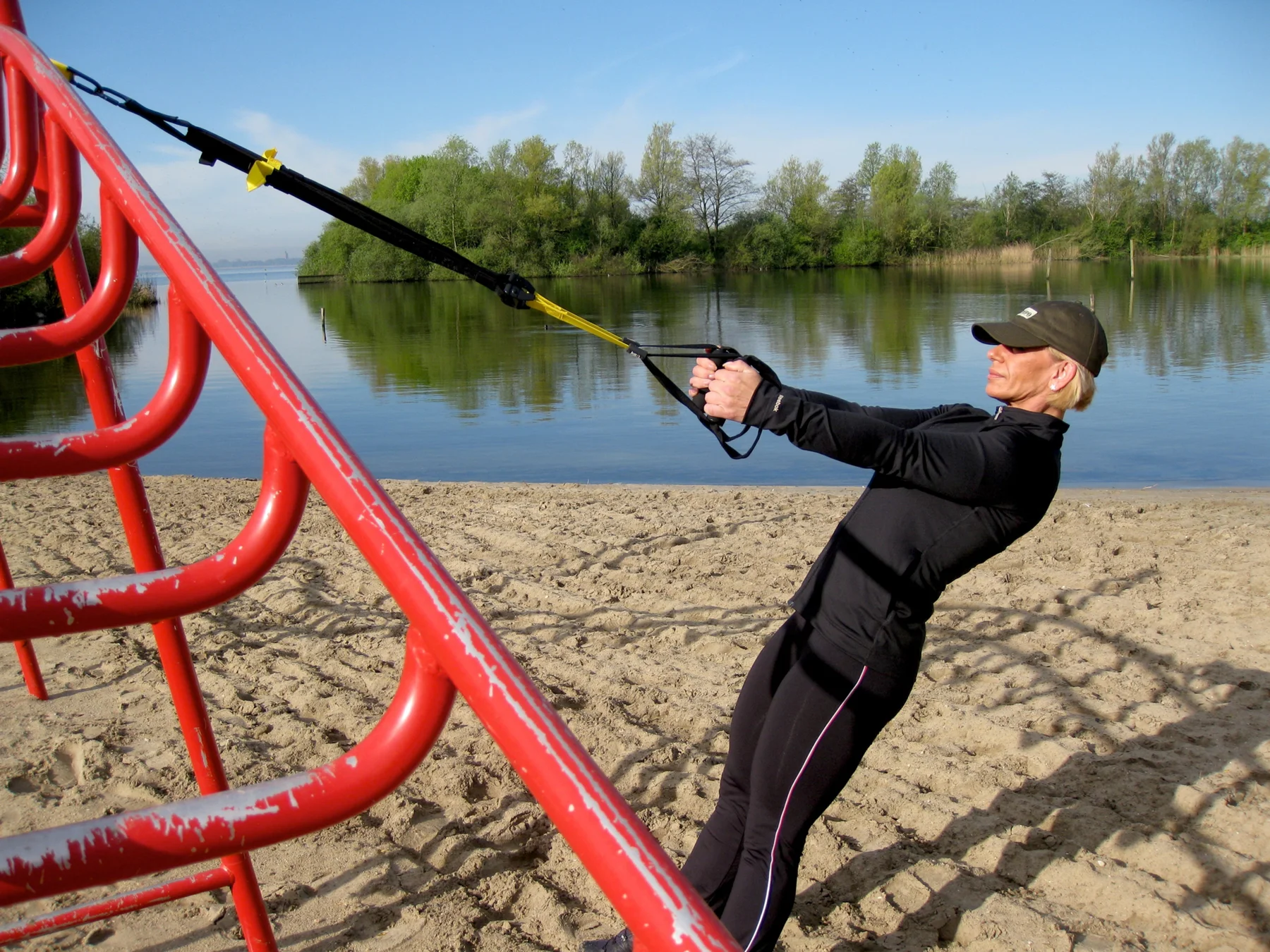
The gym is just one place to train strength.
It is a useful place. It has equipment. It has options. It has people who may or may not be doing something alarming with cable attachments.
But the gym is not the point.
The point is the signal.
Your body needs regular exposure to resistance.
That resistance can come from machines, dumbbells, barbells, kettlebells, bands, cables, suspension trainers, weight vests, loaded carries, hill walking, stairs, or bodyweight movements adjusted to your ability.
The right tool depends on the person.
A beginner may need machines because they are stable, simple, and easy to progress.
Someone training at home may need dumbbells, bands, and a few reliable movement patterns.
An older adult may need sit-to-stands, step-ups, supported hinges, rows, carries, balance work, and strength exercises that transfer directly into daily life.
A more advanced lifter may need heavier loading, planned progression, and enough recovery to avoid turning every training cycle into an identity crisis.
The method should serve the person.
Not the other way around.
A program is not better because it looks more hardcore.
A program is better when it helps someone train consistently, progress safely, and carry the benefits into real life.
Strength Training During Weight Loss Matters
This is becoming even more important now.
With more people using GLP-1 medications, more people are losing significant amounts of weight. That can be life-changing. It can also create new challenges if strength training, protein intake, and nutrition quality are not part of the plan.
Weight loss can improve health, but weight loss without attention to muscle can leave people smaller without necessarily leaving them stronger.
That is not the goal.
The goal is not to simply weigh less.
The goal is to live better in the body you have.
If someone is eating less because appetite is lower, food quality matters more.
Protein matters more.
Resistance training matters more.
Recovery matters more.
This is one of those places where fitness culture gets confused.
People celebrate the scale moving down, but the scale does not tell the whole story.
It does not tell you how much strength you kept.
It does not tell you whether your joints feel better.
It does not tell you whether you can climb stairs, carry groceries, sleep well, train consistently, or maintain the result without feeling like your life has been reduced to food math and vibes.
Strength training gives weight loss a better direction.
It helps preserve function.
It helps protect capability.
It reminds the body that muscle is still needed.
And psychologically, it can shift the goal from “How small can I get?” to “What can I do with this body?”
That is a much healthier question.
A Simple Way to Think About a Strength Plan
You do not need a perfect program.
You need a program that covers the basics and progresses slowly enough that your life can absorb it.
A simple week might include two or three full-body sessions.
Each session could include:
A lower-body movement, like a squat, sit-to-stand, leg press, split squat, or step-up.
A hinge, like a deadlift variation, hip thrust, cable pull-through, or hip hinge pattern.
A push, like a push-up, chest press, overhead press, or landmine press.
A pull, like a row, pulldown, band pull, or cable row.
A carry or core movement, like a farmer’s carry, suitcase carry, dead bug, plank, Pallof press, or loaded march.
Some balance, power, or mobility work, depending on the person.
That is enough to build from.
The exercises can change based on ability, pain, equipment, preference, and experience.
A strong 35-year-old and a deconditioned 72-year-old do not need the same version.
But they both need some version.
That is the beauty of strength training.
It scales.
You can make it harder.
You can make it easier.
You can train around injuries.
You can train at home.
You can train in a gym.
You can start with a chair.
You can eventually use a barbell.
There is almost always an entry point.
The goal is not to find the most impressive version.
The goal is to find the version you will actually do.
The Emotional Part Counts Too
People often think they need more discipline to strength train.
Sometimes they do.
But often, they need a better relationship with the work.
If every workout feels like punishment, you will eventually start negotiating your way out of it.
If every missed session becomes evidence that you are failing, you will eventually avoid the whole thing.
If every program is designed for an imaginary version of you with unlimited time, perfect sleep, no stress, no family, no work, and no history of getting annoyed by Bulgarian split squats, you will eventually quit.
That does not mean you are weak.
It means the plan was not built for your real life.
Good training should meet reality.
That includes the physical reality of your body and the emotional reality of your life.
Some seasons allow harder training.
Some seasons require maintenance.
Some seasons require rebuilding.
Some seasons require lowering the bar enough that you can keep your identity as a person who trains instead of disappearing for six months and returning with the phrase “I need to get back on track,” which is usually fitness-speak for “I tried to be perfect, exploded, and now I feel weird.”
A sustainable strength practice has room for all of that.
It can challenge you without constantly punishing you.
It can progress without demanding obsession.
It can support your life instead of consuming it.
That is the version most people need.
Strength Gives You More Room to Live
I think about this more the longer I coach.
People usually come in wanting to lose weight, tone up, feel better, or get back in shape.
Those are fine goals.
But underneath those goals is often something more important.
They want to feel capable again.
They want their body to feel less fragile.
They want to trust themselves.
They want to do normal life without everything feeling like a negotiation.
They want to age without panic.
They want to be able to say yes to things.
Yes to the trip.
Yes to the hike.
Yes to helping someone move.
Yes to playing on the floor.
Yes to taking the stairs.
Yes to carrying the cooler.
Yes to walking around all day without needing to plan the entire outing around pain, fatigue, and whether there will be somewhere to sit.
Strength gives you more yes.
That might be the best argument for it.
Not because strength solves everything.
It does not.
But it gives you more options.
And options matter.
A weaker body often has fewer options.
A stronger body usually has more.
That is not moral judgment. That is practical reality.
And reality is where we live.
The Better Conversation
The better conversation is not whether strength training is for aesthetics or longevity.
It can be for both.
It can help you look better.
It can help you feel better.
It can help you move better.
It can help you age better.
It can help you maintain weight loss.
It can help you preserve independence.
It can help you stay connected to your body in a way that is based on capability, not just appearance.
The problem is not that people care how they look.
The problem is when appearance becomes the only reason to train.
That is too small a reason for something this useful.
Strength training is bigger than that.
It is one of the most reliable ways to invest in the body you will be living in for the rest of your life.
Not the fantasy body.
Not the punishment body.
Not the comparison body.
The actual body.
The one that carries groceries, climbs stairs, gets tired, heals, adapts, ages, and keeps asking for your attention whether you like it or not.
You do not have to become obsessed.
You do not have to become a lifter as a personality.
You do not have to know every exercise, track every metric, or train like a professional athlete.
You just have to start giving your body regular reasons to stay strong.
A few times a week.
Basic movements.
Progressive challenge.
Enough recovery.
Enough patience.
That is not flashy.
It is better than flashy.
It works.
And if you do it long enough, strength training stops being something you do to fix your body.
It becomes one of the ways you keep living fully in it.
Sources
American College of Sports Medicine. “The Future of Fitness: ACSM Announces Top Trends for 2026.” ACSM’s 2026 trends report ranked Fitness Programs for Older Adults second, Balance, Flow and Core Strength fifth, and Functional Fitness Training in the top ten. ()
U.S. Department of Health and Human Services. Physical Activity Guidelines for Americans, 2nd edition. The guidelines recommend regular physical activity and include muscle-strengthening activities as part of adult physical activity recommendations. ()
Office of Disease Prevention and Health Promotion. “Increase the proportion of adults who do enough aerobic and muscle-strengthening activity — PA-05.” Healthy People 2030 reports that 26.4% of U.S. adults met both aerobic and muscle-strengthening guidelines in 2024, with only 15.5% of adults 65 and older meeting both. ()
Momma, H., Kawakami, R., Honda, T., & Sawada, S. S. “Muscle-strengthening activities are associated with lower risk and mortality in major non-communicable diseases: A systematic review and meta-analysis of cohort studies.” British Journal of Sports Medicine, 2022. This review found muscle-strengthening activities were associated with lower risk of all-cause mortality and several major non-communicable diseases. ()
Shailendra, P., et al. “Resistance Training and Mortality Risk: A Systematic Review and Meta-Analysis.” American Journal of Preventive Medicine, 2022. This review found resistance training was associated with lower all-cause, cardiovascular disease, and cancer mortality risk. ()
Centers for Disease Control and Prevention. “Older Adult Falls Data.” CDC reports that falls are the leading cause of injury for adults 65 and older, with more than 14 million older adults reporting a fall each year. ()
Liu, C. J., & Latham, N. K. “Progressive resistance strength training for improving physical function in older adults.” Cochrane Database of Systematic Reviews. This review evaluated progressive resistance training for improving physical function and muscle strength in older adults. ()
Frontiers in Nutrition. “Long-term impact of sarcopenia on functional decline and mortality in community-dwelling older adults: A systematic review and meta-analysis.” This 2025 review found sarcopenia was associated with increased risk of all-cause mortality and functional decline in community-dwelling older adults. ()
Shojaa, M., et al. “Progressive Resistance Training for Concomitant Increases in Muscle Strength and Bone Mineral Density in Older Adults: A Systematic Review and Meta-Analysis.” Sports Medicine, 2022. This review found progressive resistance training increased lower-limb strength and femur/hip bone mineral density in older adults. ()